
Simply protect your brain
An increasing number of studies suggest that our daily lives, shaped by social media, have a significant impact on the brain. And not a positive one. During Brain Awareness Week, which takes place every March, the focus is on the importance of the brain. Fortunately, because the health of our grey matter is, to a large extent, in our own hands.
3 March 2026
The human control centre
Around 11 million pieces of information are sent to the brain every second – from all our senses. Sounds in the environment, the air temperature, smells, everything we see, and on top of that, a whole host of thoughts. According to estimates, we have around 70,000 thoughts a day, which is about 49 per minute. A large proportion of this vast amount of data disappears into the subconscious and helps the body to function. Put simply, this means that our brain filters out 99.99 per cent of all stimuli. Otherwise, we would simply be overwhelmed. The brain processes conscious sensory impressions somewhat more slowly and in much smaller quantities. Estimates suggest this amounts to between 2,400 and 3,000 per minute. There is never a break for the brain.
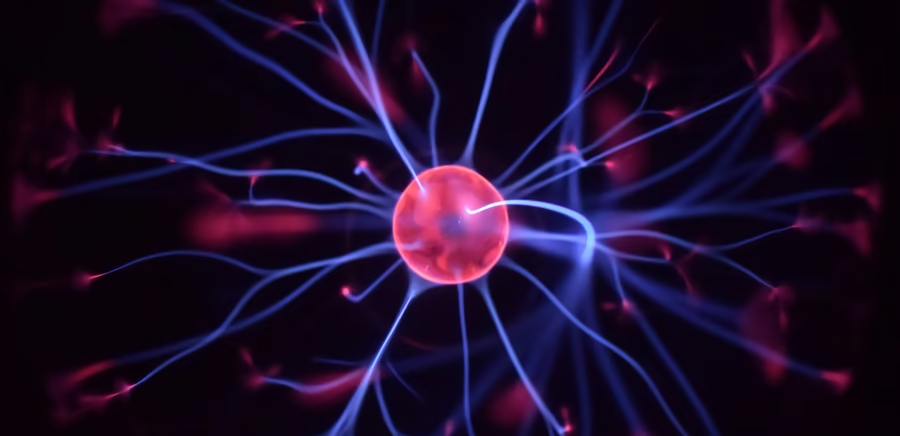
This marvel is made possible by a network of 100 billion nerve cells. They generate thoughts and feelings, transmit stimuli, control movements, regulate breathing and heartbeat, process and store information. The way they function is fascinating: the nerve cells (neurons) receive signals via dendrites (branches). These transmit the signals as electrical impulses to axons (nerve cell extensions). At the connection points, the synapses, the electrical impulses are ultimately converted into chemical messengers, the neurotransmitters. The brain remains plastic throughout life. This means it changes through learning and experience, thereby forming new networks. Each area of the brain has different functions.
Short videos are unhealthy
Anyone who realises just how complex the brain is and how it works will better understand why a life dominated by smartphones has such a detrimental effect on brain health. The term ‘brain rot’ has already become established to describe this phenomenon. Essentially, it boils down to the fact that consuming short videos has been shown to lead to a reduction in brain mass; furthermore, attention spans decrease, impulse control becomes increasingly difficult, the ability to think analytically diminishes and cognitive exhaustion increases. In short: the brain becomes passive. But why are TikTok and the like so unhealthy?
What all these platforms exploit is the fact that swiping triggers the release of dopamine in the brain. This is the neurotransmitter that puts us in a good mood and activates the reward centre. Every new video leads to a fresh release of dopamine. The brain craves more of it, and before we know it, we’re swiping across the screen again and have invented time travel: ‘Just one video’ has turned into half the morning. The rapidly changing information makes it harder to concentrate on one thing for any length of time. Our ability to understand contexts, reflect and solve problems declines. It has been scientifically proven that swiping reduces analytical thinking ability by 38 per cent. Memory function is also impaired.

A break for the brain
If you want to protect your brain, take regular breaks. Not just in the sense of consciously avoiding short videos from time to time, but also in the sense of getting away. Because travelling is like a gym for the brain. New impressions, an environment you first have to find your way around, a language you don’t (yet) understand, new smells and different sounds – all of this helps form new neural connections. The brain stays active and young.
Another factor that should not be underestimated is the stress hormone cortisol. Persistently high levels are toxic to the brain. It causes the learning centre (hippocampus) to shrink, leads to inflammation in the nervous tissue and promotes cognitive decline. Reducing stress is therefore an important step in keeping our brains healthy. And where else can you relax quite like this? That’s right, on holiday, far away from the daily grind. Another benefit of relaxation relates to the so-called ‘default mode network’. This is a region of the brain associated with creativity and problem-solving skills. Give it a go and see what surprises you might come up with whilst lounging in a deckchair by the pool at the Lemongarden Hotel...

It’s a good idea to use your holiday to work a little on your concentration and analytical thinking. It sounds tedious, but it’s actually quite enjoyable: read a good, thick book, play chess or poker with friends, or try to learn a few Croatian words. Also, make the most of the opportunity to get a really good night’s sleep in our rooms and suites. Sleep is one of the most important factors for brain health. Whilst we sleep, learning processes take place, memories are consolidated and harmful metabolic waste products are eliminated.
Tip!
Do something good for your brain – come to the Hotel Lemongarden to relax, unwind and recharge your batteries. We look forward to welcoming our guests in the new season.