![[Translate to English:] Eidechse auf Brač, © Ece Ebrar Toycu via Pexels](/fileadmin/_processed_/3/7/csm_Eidechsen_auf_Brac_8dba12b28f.avif "[Translate to English:] Eidechse auf Brač, © Ece Ebrar Toycu via Pexels")
Well-Adapted Beneficial Creatures
Nowadays, there seems to be a commemorative day for almost everything. They are particularly worthwhile when they draw attention to something that might otherwise go unnoticed in everyday life. Small animals, for example, that may be tiny but play an important role in maintaining the balance of nature. Lizards on Brač and elsewhere in the world are among them. Their commemorative day is on 14 August.
3. August 2026
Which lizards can be found on Brač?
There are mainly two species of true lizards found on the island: the Dalmatian sharp-snouted lizard (Dalmatolacerta oxycephala) and the Dalmatian wall lizard (Podarcis melisellensis).
The former is very small and has a rather flat appearance. It is found exclusively along the Adriatic coast and is therefore endemic to the region. From its head to the tip of its very long tail, it can reach a length of 20 centimetres. Its body is rather inconspicuous, often dark grey, brown or olive green. Particularly beautiful is the intense colour of its tail, which can be bright blue or blue-green. The Dalmatian sharp-snouted lizard is an excellent climber. It inhabits steep rock faces, house walls, ruins and the island’s old dry-stone walls.
The Dalmatian wall lizard is also known as the Adriatic wall lizard or karst runner. While the colour of its back provides perfect camouflage, lighter longitudinal stripes make its movements difficult for birds of prey to detect. Its underside is particularly distinctive. Adult males have either an orange belly (dominant), a lemon-yellow belly (clever and agile) or a white belly (adaptable). The males display their colours when marking their territory by raising themselves up on stones or when trying to impress females. Karst runners live mainly on the ground and are not as skilled at climbing as sharp-snouted lizards.
![[Translate to English:] Eidechse auf Brač, © Philipp Schwarz/Pexels](/fileadmin/_processed_/3/a/csm_pexels-philipp-schwarz-469323741-19451710_cc4fd386af.avif "[Translate to English:] Eidechse auf Brač, © Philipp Schwarz/Pexels")
Why lizards are so important
Insects are among lizards’ favourite foods. While wall lizards eat large numbers of beetles, ants, grasshoppers, spiders, small worms and woodlice, sharp-snouted lizards feed on flies, mosquitoes, horseflies and spiders. In doing so, they not only ensure that no single insect species becomes too dominant, but also help reduce the number of mosquitoes and other insects that bother the island’s human residents.
The lizards themselves are also an important source of food. Without them, falcons, buzzards, owls, non-venomous snakes and rodents on Brač would lose an important part of their diet.
With its flat head and colourful tail, the sharp-snouted lizard has two “weapons” that can help it survive an attack: its flat head allows it to squeeze into even the narrowest cracks in walls. Birds and rodents cannot follow it there. If a predator attacks, its attention is first drawn to the brightly coloured tail. The sharp-snouted lizard can simply detach it.
Survival experts in every climate
Lizards feel most comfortable at temperatures of around 32 to 35 °C. In spring, they can often be seen basking in the sun all day. In midsummer, they disappear around midday, when temperatures are at their highest. They are then mainly active in the morning and evening.
It can be quite amusing to watch them run across hot sand. To avoid burns, they move almost as if they were walking on stilts, keeping their bellies as far away from the ground as possible. Their scales help prevent them from drying out. As they are waterproof, wind cannot draw moisture from their bodies.
Because lizards obtain all the water they need from their food, the fact that there is hardly any open fresh water on the island during the hot summer months is not much of a problem for them. Accordingly, their urine is not liquid either, but is excreted as solid uric acid.
The wall lizard also retreats into dense Mediterranean scrub when it becomes too hot. The sharp-snouted lizard, meanwhile, seeks shelter in cool crevices in the rocks. During winter, the lizards enter a period of dormancy.
![[Translate to English:] Steinmauer, © BARIŞ KARANLIK/Pexels](/fileadmin/_processed_/5/c/csm_Eidechsen_auf_Brac__1__4614513ef1.avif "[Translate to English:] Steinmauer, © BARIŞ KARANLIK/Pexels")
World Lizard Day aims to raise public awareness of the importance and unique characteristics of these animals. They are often overlooked because most people do not consider them cute, and a lack of knowledge sometimes even causes people to react to them with aversion or disgust.
So when our guests spot a lizard on Brač, they can consider it a good sign. It means that natural insect control is at work and that the flora and fauna in and around Hotel Lemongarden are in balance.
Tipp!
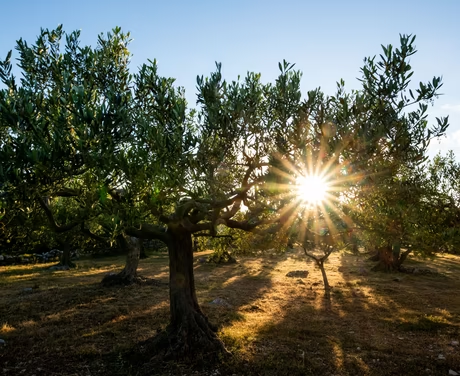
If you see a lizard, do not frighten or touch it, as this may cause unnecessary stress. One of the best places to encounter these fascinating animals is our olive grove!