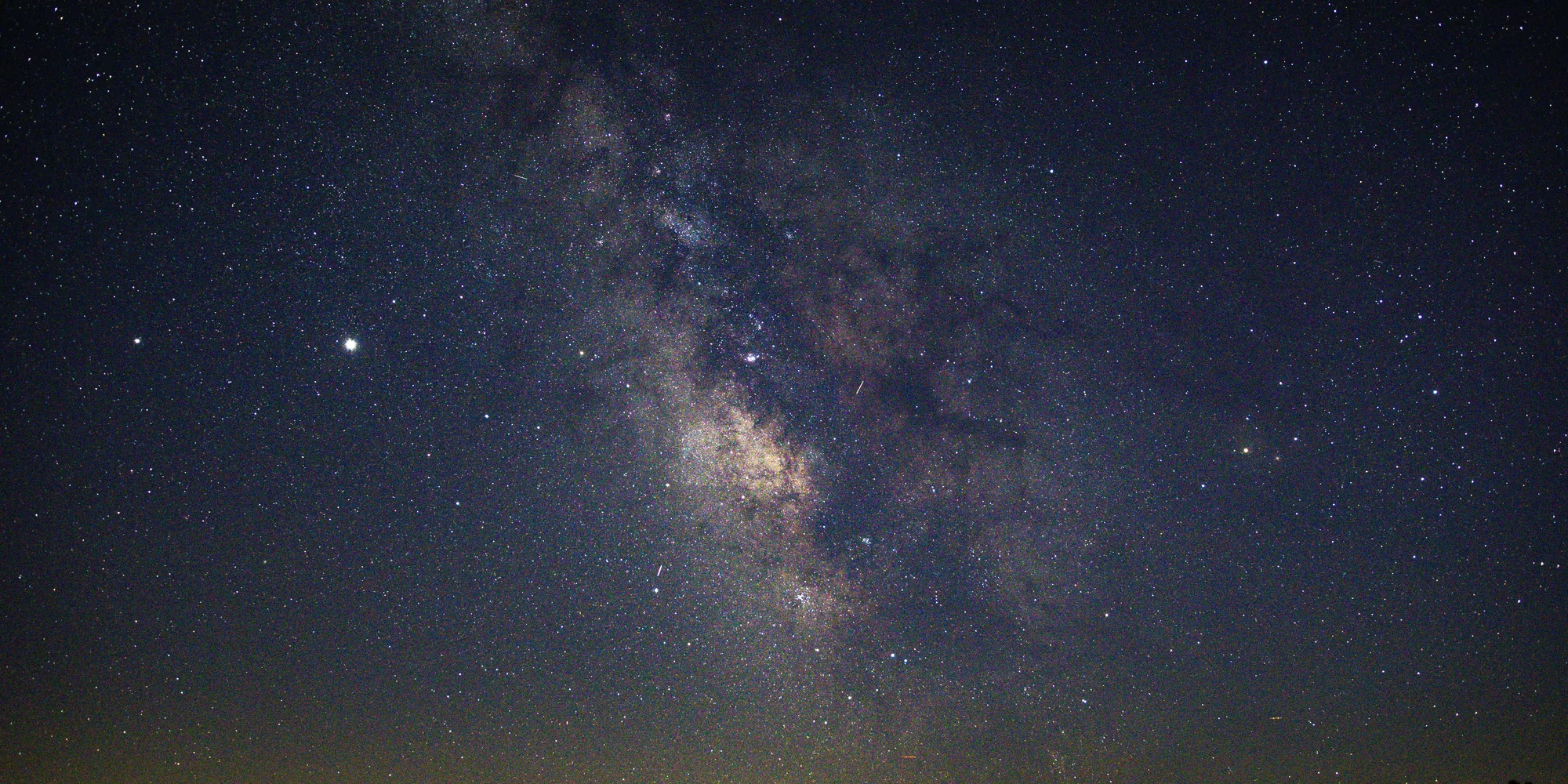
The night sky over the island
In 1973, Doug Berger, then president of the Astronomical Society of Northern California, launched International Astronomy Day. He wanted to inspire more people to take an interest in the night sky. World Astronomy Day has since become so popular that it is now celebrated twice a year: in the spring and in the fall. The next one will be on September 19. Of course, you don’t need an international observance to gaze at the stars over Brač.
August 3, 2026
The Fascination of Space
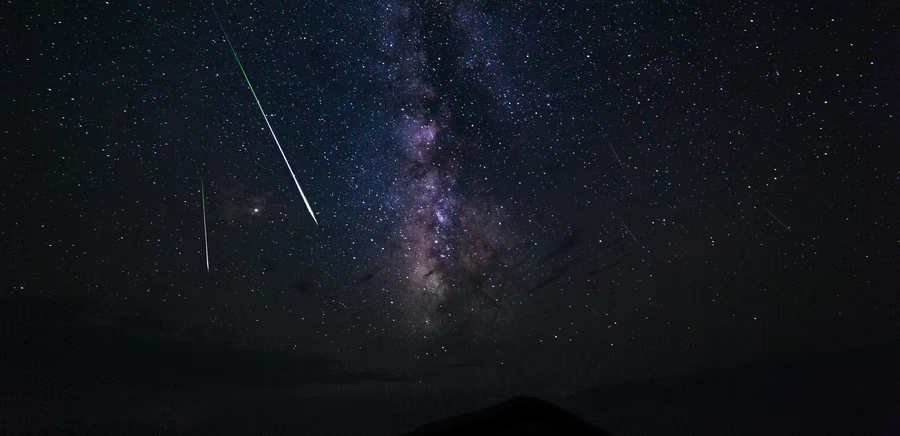
When the stars twinkle above us and perhaps even the occasional shooting star traces its luminous path across the night sky, most people can’t help but be filled with wonder. Perhaps this feeling stems from the comforting certainty that our ancestors gazed upon the very same stars, and that some things truly do endure across generations. Perhaps it’s also a sense of humility in the face of the incomprehensible vastness of the universe. Or simply pure fascination. It’s not just during the famous Perseid nights in midsummer, when a particularly large number of shooting stars can be seen, that it’s worth looking up.
In September, for example, it gets dark earlier and the nights are long. The weather is usually still pleasantly mild, creating ideal conditions for stargazing on Brač. There’s little light pollution over the sea, and since there are no large cities, the stars in the night sky above the island are a sight to behold anyway. The coming months also have a few highlights in store for astronomy enthusiasts: Saturn is opposite the Sun. This means it’s particularly well illuminated and reaches its peak brightness for the year. It’s clearly visible in the south.
Brač and Astronomy
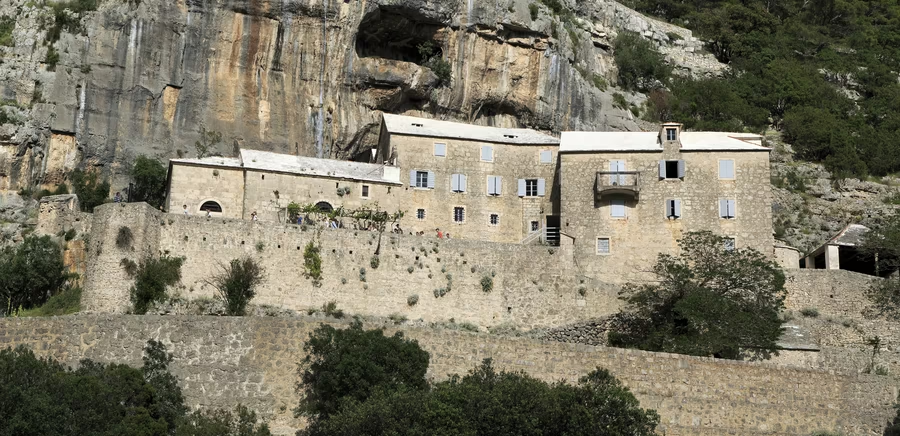
Stargazing on Brač—this tradition dates back a very long time. That’s because Croatia’s third-most-powerful telescope once stood here—more precisely, at the Blaca Hermitage. This is a hermitage founded in the 16th century by Catholic priests. At first, they simply sought shelter in a cave, but little by little, the men built a monastery and a church. They led a frugal life in seclusion.
The last monk and head of the monastery, Father Nikola Miličević, was a passionate astronomer. In the early 20th century, he purchased a telescope in Austria that caused quite a sensation. It was the largest telescope in the Balkans, remains the third-most powerful telescope in all of Croatia to this day, and weighed 900 kilograms. It had to be laboriously transported to the hermitage using only physical strength and the help of donkeys. Incidentally, it still stands there today and can be viewed as part of a guided tour.
World-Famous Astronomer on Brač
Miličević even made discoveries of scientific significance. He discovered two novae—sudden bursts of brightness. He also identified two comets in the northern sky. The monk also worked on calculating orbits and published regularly in the Viennese journal "Astronomical News". The precision of his calculations impressed the astronomical community; Miličević maintained a constant correspondence with major observatories in the United States.
That alone represented a logistical effort that is unimaginable today: Naturally, there was no electricity or telephones in the Blaca Valley. Letters from the U.S. arrived at the port of Split, were transported on to Brač, and from there were brought to the monastery by the monks on foot or by donkey. Despite international recognition within the scientific community, the monk led a modest and God-fearing life. It would never have occurred to him to name celestial phenomena after himself. However, in 2005, the International Astronomical Union honored the Croatian astronomer in two ways: Celestial body 10241 was officially named Nikola Miličević, and celestial body 10645 was named Brač.
The night sky over Brač
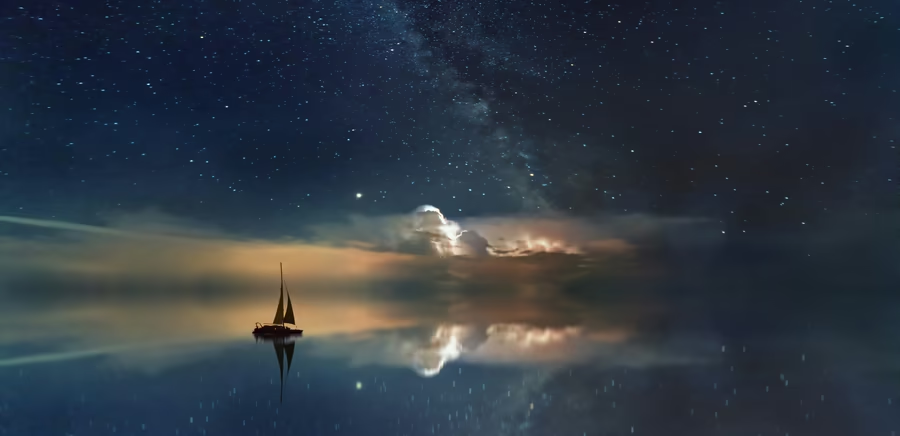
Would you like to enjoy unforgettable views of the night sky? Numerous spots on Brač are ideal for stargazing and astrophotography. In several places on the island, you can see the Milky Way with the naked eye—for example, from the summit of Vidova Gora. You can drive all the way up, so you don’t have to carry heavy equipment very far. Above the Blaca Valley, near the parking lot, it’s completely dark. This is where Miličević conducted his observations.
South of Bol and Murvica are secluded coves that offer excellent stargazing. Behind you are the cliffs, which block out all light pollution. Ahead of you lies the open sea, over which it is particularly dark—so dark that the Milky Way stands out in striking contrast.
Tip!
If you'd like to go on a nighttime excursion, you can rent one of our Mini Coopers. Be sure to choose an evening with a clear sky and no full moon. The new moon phase is ideal. Avoid using smartphone screens so your eyes can adjust to the darkness.